
Dreaming of agrarian reform
What are examples of agrarian reform that you find inspiring? What are your dreams for the food system?

Read the newsletter below or follow the links for a 9 minute watch or listen!
A capitalist food system is designed neither to feed us nor to last, but rather to exploit workers and environments for the enrichment of an increasingly smaller and wealthier group of people. I learned this most recently while researching and interviewing for the No Land Farms podcast on the Delmarva Peninsula's broiler industry. When I began that project, it wasn't long before I heard the phrase "Get big or get out" to describe the experiences of U.S. farmers.
Between 1935 and the most recent Census of Agriculture published in 2024, the average farm size rose while the number of farms decreased more than 72% from 6.8 million to 1.88 million farms. The consolidation of farmland is so severe that about 61% of U.S. farmland is controlled by farms in the largest size class of 2,000 acres or more. Farmers have been losing their farms for over ninety years in large part to the development of large-scale, industrial agriculture. It's a fragile system of agriculture that, as outlined by the International Panel of Experts on Sustainable Food Systems (iPES Food), yields land degradation, soil erosion, water contamination, biodiversity loss, the spread of disease and antibiotic resistance, reliance on fossil fuels, and climate change. In the Chesapeake region, the Chesapeake Bay Program notes that agriculture is "the single largest source of nutrient and sediment pollution entering the Bay." Our current dominant food system damages the environments from which food is grown and abuses animals while sacrificing workers to high rates of injuries and illnesses, rural communities to unhealthy environments, and the public to hunger and nutrient deficiencies. In addition to these devastating consequences, iPES Food authors explain that industrial agriculture produces cultural erosion, “[altering] the fundamental relationship between humans and nature." Instead of cultivating the health and well-being of people and the interconnected, multi-species environments that we inhabit, industrial agriculture concentrates capital and swells the market control and profits of the largest landowners and corporations. Food systems, however, do not have to be built for private profit.

For example, on May 17th, 1959, Fidel Castro signed Cuba's first Agrarian Reform Law, establishing a maximum landholding of about 402 hectares. The law, which incorporated compensation and exceptions, served to prevent further consolidation and to transition farmland from the largest owners and U.S. monopolies to landless peasants and farmworkers. Workers were provided farmland directly or through cooperatives supported by a new government agency, the National Institute of Agrarian Reform, and the groundwork was laid for future reforms striving to dismantle the colonial food system.


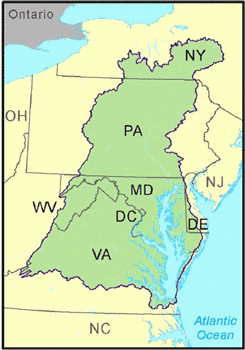
Dreaming of agrarian reform in the Chesapeake Bay watershed, I became curious about what Cuba's 1959 maximum landholding would look like here. Using the Chesapeake Bay Program's map of counties fully or partially in the watershed and farm size data collected by the USDA's Census of Agriculture, I created a spreadsheet of the watershed's largest farms. Since 402 hectares is equivalent to around 993 acres, I defined the largest farms as those classified as equal to or greater than 1,000 acres. In summary, the data revealed that the watershed's largest farms control about 31% of the farmland, despite being just 3% of farms. More strikingly, Delaware's largest farms, making up nearly 8% of the state's farms, possess about 61% of Delaware's farmland. If the Chesapeake Bay's watershed counties instituted a maximum landholding of 1,000 acres, then there would be at least 2.26 million acres of farmland available for distribution. I note "at least" because, considering the farms that refuse to disclose acreage and the Census' multitude of information gaps, I can only provide an underestimate.
Imagine, agrarian reform could be a path for land back to indigenous peoples, a path toward reparations for people enslaved and imprisoned by the U.S. empire and their descendants, and a path for distributing land to farmworkers and agricultural laborers. It could not only recognize how the U.S. has dispossessed people of their homes and violated their relationships with the land, but also function to nurture a food system beyond one that consolidates land ownership, concentrates capital, and degrades our environments.

While dreaming, it's worth knowing that the U.S. responded to Cuba's revolution and anti-imperialist reforms with violent interventions, a decades-long and ongoing embargo, and other schemes for economic isolation. The U.S.'s current fuel blockade is causing an active humanitarian crisis, and U.N. human rights experts have explained that Cuba's "Energy, transport, irrigation and basic services are failing simultaneously, disproportionately affecting women, children, older persons and other vulnerable groups, including peasant farmers in the rural economy." Energy blackouts and supplies shortages directly interfere with Cuba's free healthcare system, leading to illnesses and deaths that would not have occurred otherwise.
So, why does the U.S. perceive Cuba as a threat? In Blackshirts and Reds, Michael Parenti unravels that, to global capitalists, "Cuba's real sin is that it has tried to develop an alternative to the global capitalist system, an egalitarian socio-economic order that placed corporate property under public ownership, abolished capitalist investors as a class entity, and put people before profits and national independence before IMF [International Monetary Fund] servitude." Parenti's words are an illuminating companion to the U.S. government's recent report, "Cuba: The Capital of 21st Century Communism." Unsurprisingly cast as a villain throughout the report, Fidel Castro also made efforts to clarify the U.S.'s anti-Cuba narrative. Here's a piece from his 1961 May Day speech to end the second Crabby Cat.
"The US government says that a socialist regime here threatens US security. But what threatens the security of the US people is the aggressive policy of the warmongers of the United States. What threatens the security of the North American family and the US people is the violent, aggressive policy that ignores the sovereignty and the rights of other peoples...We do not endanger the security of a single North American. We do not endanger the life or security of a single US family. We are making cooperatives, agrarian reform, people's farms, houses, schools, literacy campaigns, and sending thousands and thousands of teachers to the interior [of Cuba], building hospitals, sending doctors, giving scholarships, building factories, increasing the productive capacity of our country, creating public beaches, converting fortresses into schools, and giving the people the right to a better future."

Thank you for reading! What are other examples of agrarian reform that you find inspiring? What are your dreams for the food system?